Introduction
Bought a life insurance policy because an agent convinced you it’s “investment plus protection”? You’re not alone — this happens to thousands of people every year in India, and honestly, a lot of them end up underinsured. The term insurance vs life insurance debate isn’t really close once you understand what each product actually does. Let’s cut through the sales pitch.
What’s the Actual Difference?
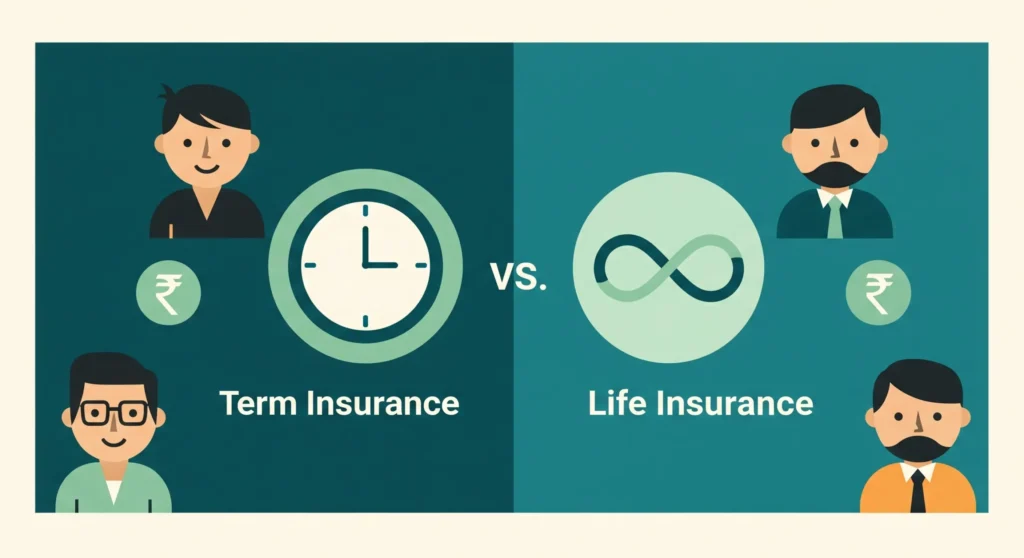
In short: In the term insurance vs life insurance comparison, term insurance offers pure life cover at a low premium with no maturity benefit, while traditional life insurance (endowment, whole life) combines a smaller death benefit with an investment component, usually at a much higher premium for the same coverage amount.
Term insurance pays out only if the policyholder passes away during the policy term. Traditional life insurance often pays out either way — death or survival till maturity — but at a steep cost.
Cost Comparison That’ll Surprise You
For a 30-year-old non-smoker wanting ₹1 crore coverage for 30 years:
- Term Insurance: Roughly ₹12,000-15,000 annual premium
- Traditional Endowment Plan for similar coverage: Could cost ₹80,000-1,00,000+ annually, and often still gives you far less than ₹1 crore coverage
That gap is enormous, and it’s the single biggest reason financial advisors (the honest ones, anyway) push term insurance first.
Why Do Agents Push Traditional Life Insurance More?
Commission structures, plain and simple. Traditional policies pay agents significantly higher commissions than term plans, which creates an obvious incentive misalignment.
I’ve noticed relatives proudly showing off their “investment-cum-insurance” policy, only to realize years later the returns barely beat a fixed deposit, while the actual life cover was laughably inadequate for their family’s needs.
[link to related guide on best family health insurance here]
When Might Traditional Life Insurance Still Make Sense?
- You’ve maxed out other tax-saving investment options and want forced savings discipline
- You genuinely value the guaranteed (though modest) returns over market-linked options
- You’re close to retirement and want a shorter-term guaranteed payout instrument
Even then, most financial planners would suggest keeping insurance and investment separate rather than bundling them.
How Much Term Insurance Coverage Do You Need?
A common rule of thumb: 10-15 times your annual income, adjusted for outstanding loans and future goals like children’s education.
- Calculate annual expenses your family would need covered
- Add outstanding loan amounts (home loan, car loan, etc.)
- Add future goals — education, marriage, etc.
- Subtract existing savings and investments
[link to related guide on financial planning in your 20s here]
A Real-World Scenario
Picture a 32-year-old marketing manager in Jaipur, sole earner for his family, who’d been paying ₹45,000 annually for a traditional policy giving just ₹15 lakh coverage. Switching to a term plan, he got ₹1.5 crore coverage for roughly ₹18,000 annually — freeing up substantial money to invest separately in mutual funds instead.
Common Objections to Term Insurance (And Why They’re Weak)
- “I get nothing back if I survive” — True, but that’s exactly why it’s cheap; you’re paying purely for risk cover, not building an investment
- “What if the claim gets rejected?” — Choose insurers with high claim settlement ratios (above 97-98%) and disclose all health details honestly to avoid this entirely
FAQs
Is term insurance enough, or do I also need traditional life insurance? For most people, term insurance alone covers the protection need adequately; investments are better handled separately through mutual funds or PPF.
Can I buy term insurance online without a medical test? For lower coverage amounts and younger applicants, some insurers offer instant approval, but higher coverage typically requires a medical checkup.
What happens if I outlive my term insurance policy? You don’t receive any payout — the premium paid was purely for the risk cover during that period, similar to how car insurance works.
Is term insurance premium the same for men and women? Women often get slightly lower premiums due to statistically longer life expectancy, though this varies by insurer.
Can I increase my term insurance coverage later? Some policies allow it at specific life stages (marriage, childbirth) without additional medical tests, depending on the insurer’s terms.
Conclusion
The term insurance vs life insurance decision really isn’t a close call for most people — term insurance gives you significantly more coverage at a fraction of the cost, letting you invest the difference more effectively elsewhere. Don’t let a well-meaning agent’s commission incentive shape your family’s financial protection. Calculate your actual coverage need today and get a term plan sorted — it’s one of the most important financial decisions you’ll make, and one of the cheapest to get right.
Suggested Alt Text:
- “Comparison chart of term insurance vs life insurance premiums”
- “Family reviewing term insurance policy documents together”