Whether you are saving in a bank deposit, taking a loan or investing for the long term, interest is at work behind the scenes. Yet many people compare financial products by looking only at the headline rate, without asking how that interest is calculated. That question matters, because the same principal and the same rate can produce very different outcomes depending on the method.
This guide explains simple vs compound interest, shows both formulas with a worked example, compares growth over 5, 10 and 20 years and covers where each method appears in real life. By the end, you should be able to read the fine print of a financial product with more confidence.
What Is Simple Interest?
How simple interest works
Simple interest is calculated only on the original amount, called the principal. Interest earned in earlier periods is not added to the base for later periods. As long as the principal and the rate stay the same, the interest amount is the same every period. This gives a steady, straight-line pattern of growth.
Simple interest formula with an example
The simple interest formula is:
SI = (P × R × T) ÷ 100
- P is the principal, the amount invested or borrowed
- R is the annual rate of interest (in percent)
- T is the time in years
Simple interest example: Suppose you invest ₹50,000 at 8% per year for 3 years.
SI = (50,000 × 8 × 3) ÷ 100 = ₹12,000
The total amount at the end of 3 years is ₹50,000 + ₹12,000 = ₹62,000. You earn ₹4,000 every year, no more and no less.
What Is Compound Interest?
How compound interest works
Compound interest is calculated on the principal plus the interest accumulated so far. In other words, you earn interest on your interest. After each compounding period, the interest is added to the balance, and the next period’s interest is calculated on this larger amount. This is how compound interest works, and it is the reason growth accelerates over time.
Compound interest formula with an example
The compound interest formula is:
A = P × (1 + r/n)^(n×t)
- A is the final amount
- P is the principal
- r is the annual interest rate as a decimal (8% = 0.08)
- n is the number of times interest is compounded per year
- t is the time in years
The compound interest earned is A − P.
Worked example: Take the same ₹50,000 at 8% for 3 years, compounded annually (n = 1).
A = 50,000 × (1.08)³ = 50,000 × 1.259712 = ₹62,985.60
Compound interest = ₹62,985.60 − ₹50,000 = ₹12,985.60
Year by year, the interest is ₹4,000 in year one, ₹4,320 in year two and ₹4,665.60 in year three. It rises because each year’s interest is calculated on a bigger balance.
Simple Interest vs Compound Interest: Key Differences
The difference between these two methods becomes clearer when you compare their formulas and calculate the final amount using the same principal, rate and time period. For a more detailed explanation, see this guide to simple and compound interest, which includes worked examples, a side-by-side comparison and the effect of compounding frequency.
Difference in calculation method
Simple interest always uses the original principal. Compound interest uses a balance that grows each period as interest is added.
Difference in growth over time
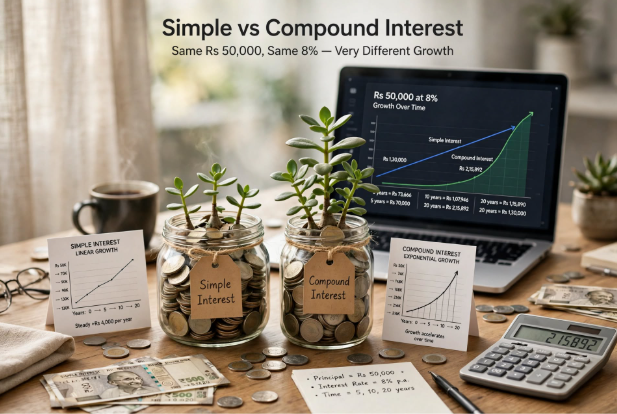
Simple interest produces linear growth, a straight line. Compound interest produces compounding growth, a curve that gets steeper the longer the money stays invested.
Difference in total interest earned or paid
For the same principal, rate and period, compound interest generally results in a larger total, whether that works in your favour (as a saver) or against you (as a borrower). In our example, the 3-year gap is ₹985.60, which is small. Over longer periods it grows significantly, as shown below.
| Feature | Simple interest | Compound interest |
| Calculation base | Original principal | Principal plus accumulated interest |
| Growth pattern | Linear | Compounding growth |
| Interest per period | Generally constant | Generally increases as the balance grows |
| Common relevance | Some loan and interest calculations | Deposits and reinvested investment returns |
How Much Difference Does Compounding Make Over Time?
To see the power of compounding, we use one consistent example: ₹50,000 at 8% per year, with compound interest compounded annually.
| Period | Simple interest total | Compound interest total | Extra from compounding |
| 5 years | ₹70,000 | ₹73,466 | ₹3,466 |
| 10 years | ₹90,000 | ₹1,07,946 | ₹17,946 |
| 20 years | ₹1,30,000 | ₹2,33,048 | ₹1,03,048 |
Short-term comparison
Over 3 to 5 years, the difference looks modest. A ₹3,466 gap on ₹50,000 after five years may not feel dramatic, which is why some people underestimate compounding.
Long-term comparison
Over 20 years, simple interest adds ₹80,000 to the principal, while compound interest adds about ₹1,83,048. The compounded total is more than 4.5 times the original principal, whereas the simple-interest total is 2.6 times.
Why the gap becomes larger over longer periods
Each year, compounding applies the rate to a larger base, so the extra interest builds on itself. The first years do the “setup”, and the later years deliver most of the growth. This is why long-term investment growth depends so much on staying invested for a long time.
Important: These figures assume a fixed 8% rate for illustration. Market-linked investments do not deliver a fixed or guaranteed return. Their returns can be higher, lower or negative in any given year.
Where Are Simple and Compound Interest Used?
Simple interest in borrowing and lending
Simple interest is used in some short-term loans, certain informal lending arrangements and many classroom or quick-estimate calculations. Note that simple interest in loans is not universal. Many bank loans, such as home and car loans, calculate interest on the outstanding (reducing) balance, and each lender has its own terms. Always check the loan agreement for how interest is charged.
Compound interest in fixed deposits and savings
Compound interest in FD products is common. Many bank fixed deposits compound interest quarterly in their cumulative option, so interest is reinvested and paid at maturity. Non-cumulative options pay interest out periodically, which means it is not reinvested automatically. Check the product’s terms for the compounding frequency and payout option.
Compounding and mutual fund investments
Compounding in investments such as mutual funds works through reinvested returns. When gains stay invested, they can contribute to future growth. But mutual fund returns are market-linked and are not fixed interest. There is no promised rate, so the compound-interest formula can only illustrate possibilities and cannot predict actual results.
If you want to test your own numbers, this calculator and guide can help:
How Compounding Frequency Affects Returns
The compounding frequency is how often interest is added to the balance. The more frequently it is added, the sooner interest starts earning interest, so the final amount generally rises slightly.
Using ₹50,000 at 8% per year for 3 years:
| Compounding frequency | n | Final amount |
| Annual | 1 | ₹62,985.60 |
| Half-yearly | 2 | ₹63,265.95 |
| Quarterly | 4 | ₹63,412.09 |
| Monthly | 12 | about ₹63,512 |
Annual compounding
Interest is added once a year. This is the baseline in our earlier examples.
Half-yearly and quarterly compounding
With quarterly compounding, interest is added four times a year. The rate per period becomes 2% (8% ÷ 4) over 12 periods, which gives a higher final amount than annual compounding.
Monthly compounding
With monthly compounding, the rate per period is about 0.667% over 36 periods. The result is higher again, but the gain from moving to more frequent compounding gets smaller each time.
The effect is real but modest compared with the effect of time and rate. When comparing products, always check the actual terms, because two products with the same stated rate but different compounding frequencies will not give the same return.
Common Mistakes People Make When Calculating Interest
- Confusing annual interest rates with total interest. An 8% annual rate over 3 years is not 8% in total.
- Ignoring compounding frequency. Two products with the same rate can pay differently.
- Comparing investments with different tenures. A 5-year and a 10-year return cannot be compared directly without adjusting for time.
- Ignoring fees, taxes and inflation. The net, after-tax, after-inflation return is what actually grows your purchasing power.
- Assuming market-linked returns are guaranteed. Illustrations assume a constant rate, which markets do not provide.
How to Choose Between Simple and Compound Interest
You rarely get to “choose” the method directly, because products come with their own terms. But you can choose between products, and the method matters in that comparison.
Consider whether you are borrowing or saving
As a saver, compounding works for you, so you generally want more frequent compounding and longer tenures. As a borrower, compounding works against you, so check how interest accrues and whether you can repay early without heavy penalties.
Compare the actual rate and calculation method
Look beyond the headline rate. Check whether interest is simple or compound, how often it compounds and whether the quoted figure is an annual rate or an effective yield.
Consider your financial goals and time horizon
For long-term goals, compounding has more time to work, so keeping money invested and reinvesting returns can matter greatly. For short-term needs, the difference between methods is small, and liquidity and safety may matter more.
Frequently Asked Questions
1. What is the main difference between simple and compound interest?
Simple interest is calculated only on the original principal, while compound interest is calculated on the principal plus the interest already earned.
2. Which is better for long-term savings: simple or compound interest?
Compound interest generally gives a higher total over long periods, because interest earns further interest. The advantage grows with time and with more frequent compounding.
3. How do you calculate simple interest?
Use SI = (P × R × T) ÷ 100. For example, ₹50,000 at 8% for 3 years gives ₹12,000.
4. How do you calculate compound interest?
Use A = P × (1 + r/n)^(n×t), then subtract the principal. For ₹50,000 at 8% compounded annually for 3 years, A is ₹62,985.60 and the interest is ₹12,985.60.
5. Does compound interest apply to fixed deposits and mutual funds in the same way?
No. Fixed deposits state an interest rate and compounding terms in advance. Mutual funds are market-linked, with no fixed rate, so “compounding” only describes how reinvested returns can build on one another and does not guarantee any outcome.
Conclusion
Simple interest grows in a straight line, while compound interest grows in a curve that steepens over time. The gap is small in the early years and large over decades, which is why time matters as much as the rate. Before choosing any savings, loan or investment product, understand how interest is calculated, how often it compounds, what the tenure is and what risks apply.
Compare rates, duration, compounding frequency and risk, not just the headline return, and use calculators for estimates while remembering they are illustrations, not promises